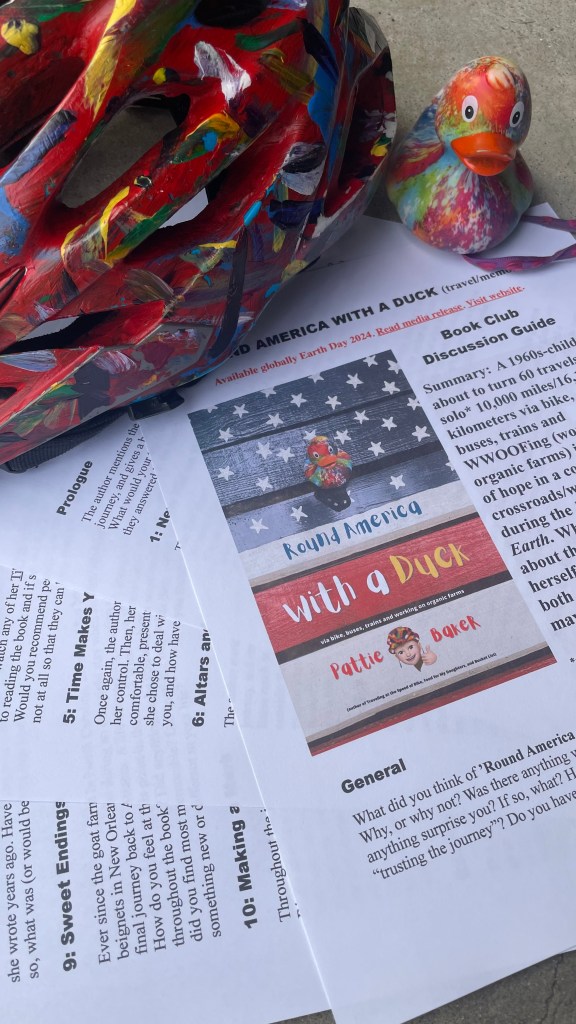
It’s time to add Round America with a Duck to your book club schedule this year! Both paperback and e-book versions are on target for release March 20, 2024. This free guide is sure to enliven your group discussion. Feel free to contact me if you want me to attend your book club virtually to answer questions during National Bike Month in May, and/or if you want ducky stickers to give to your club participants (while supplies last). Click here to download the quick-read four-page guide in PDF form (reprinted below in this blog post as well):
ROUND AMERICA WITH A DUCK (travel/memoir)
Book Club Discussion Guide
Visit website for links to purchase books.
General
What did you think of Round America with a Duck? Would you recommend it? Why, or why not? Was there anything with which you particularly identified? Did anything surprise you? If so, what? How did you feel about the author’s belief in “trusting the journey”? Do you have a mantra that guides you?
Prologue
The author mentions the “number 2” question many people asked her prior to her journey, and gives a brief glimpse into how the answer to that question played out. What would your top few questions be to the author prior to her journey? Were they answered in the book?
1: New Kid on the Block
The first chapter takes us from when she left her husband and home in Metro Atlanta through her first farm work-stay at a repurposed goat farm in North Carolina. Faced with some early challenges, she tells us that she has decided to adopt a practice she calls “radical non-judgment” and has also decided not to tell everything that happens in order to preserve the privacy and dignity of people she meets along the way when that seems like the right thing to do. How does this decision make this memoir different from many others?
2: Rocky Steps and Groovy Bridges
With time on trains and buses to think throughout the journey, including on the way to Philadelphia and then New York in this chapter, the author mentions that there are other ways to live a life. Have you ever thought about what your life would have been like (or could still be like) if you made (or make) different decisions about it? What have you always wanted to do? What would you still be willing to do? How much thought about your own life does this book provoke?
3: No Horsing Around
After a 30-hour trip on three different buses, the author finds one of the greatest challenges of the journey at her next scheduled farm work-stay near a ghost town by Route 66 in Missouri. It almost ends the entire journey. Have you faced a situation that threatened to end everything you were pursuing? How did you react to it? What happened next?
4: Heaven on Earth
The author faces a dramatic new reality when she arrives at her next farm workstay. How did you visualize the alpaca ranch and eco-spirituality center in Kansas?
Did you watch any of her TikTok videos tagged #RoundAmericaWithADuck prior to reading the book and if so, did that have an impact on your reading of the book? Would you recommend people view the videos before or after reading the book, or not at all so that they can keep their own vision of the locations in their minds?
5: Time Makes You Bolder
Once again, the author’s journey is almost derailed due to circumstances beyond her control. Then, her work-stay in Boulder, Colorado, although physically comfortable, presents some mental challenges for her. How do you feel about how she chose to deal with them? What kind of situations present mental challenges for you, and how have you found it most successful for you to embrace them?
6: Altars and Halters
The author mentions meeting and working with many powerful women throughout the journey, and one of the most powerful is at her work-stay at the Krishna Temple and llama ranch in Utah. Have you met particularly powerful women, and what do you consider their power to be? Throughout the book, she additionally shares challenges to women’s safety in public and the oversized potential positive impact of women to local economies, especially when they ride bikes. How has the author’s identity as a woman and a bike-rider shaped her journey? How does how you identify shape yours?
7: Hot Streak
In this chapter, the author mentions her shoes melting in Las Vegas during a heat wave. Throughout the journey, she encounters every type of climate challenge you can imagine. Does our changing climate impact your daily life or long-term planning? The author offers some surprising suggestions for skills, gleaned from her journey, for surviving a climate disaster. Had you given thought to these suggestions prior to this book? Do you have any other survival tips that have already come in handy?
8: La La Land
Reunited with family for the second time during the journey following a final work-stay in the High Desert of California, the author culminates her cross-country expedition with an action of great meaning to herself and bike riders everywhere, which she shares with her family. What symbolic gesture in your life had great meaning? What do you still imagine doing and then commemorating in a memorable way? The author also shares the first line to an “aspirational obituary” she wrote years ago. Have you ever considered writing an aspirational obituary? If so, what was (or would be) its first line?
9: Sweet Endings
Ever since the goat farm in North Carolina, the author has been imagining getting beignets in New Orleans during an overnight stay when switching trains on her final journey back to Atlanta. A life-threatening situation almost creates havoc. How do you feel at this point in the book? What were your overall feelings throughout the book? Did anything make you laugh or cry? What place or scene did you find most memorable? Did anything inspire you to consider doing something new or different in your life?
10: Making a Mark
Throughout the journey, the author searches for — and shines a light on — hope. Right after she returns home, she takes an action that leaves an indelible mark on her body and on her potential for making an impact in the world just be being. This ties in with a sweatshirt she wore throughout the journey as a message not just to herself but to those around her as well. In the book, the author makes a point of communicating the phone/text number 988, which is the USA nationwide Suicide Crisis Hotline, where trained professionals can listen non-judgmentally and connect people to resources. Is there a final message of hope you want to share as well?
Reviews
The author shares the actual reviews her WWOOF work-stay hosts posted on her profile on the global WWOOF website. Did you find it interesting to read their reviews, after reading the book? Did the author’s journey have an impact on your impression of WWOOFing, and your likelihood of doing it yourself or recommending it to others? Did the fact that the author turned 60 years old during the journey change your impression of WWOOFing or other solo travel as an opportunity for all ages?
Thank you for reading Round America with a Duck. If you loved it, please consider giving it a five-star review on book review sites. You may also enjoy my other books, Bucket List, Food for My Daughters, and Traveling at the Speed of Bike. If you would like me to attend your book club meeting virtually to answer questions, feel free to email me to arrange. Trust the journey — Pattie
Discover more from Round America (and Ireland!) with a Duck
Subscribe to get the latest posts sent to your email.

